
Have you ever been in someone’s home and decided you absolutely had to have their wall color in your own home? But when you painted your own room, the color looked quite different? What’s up with that? Metamerism.
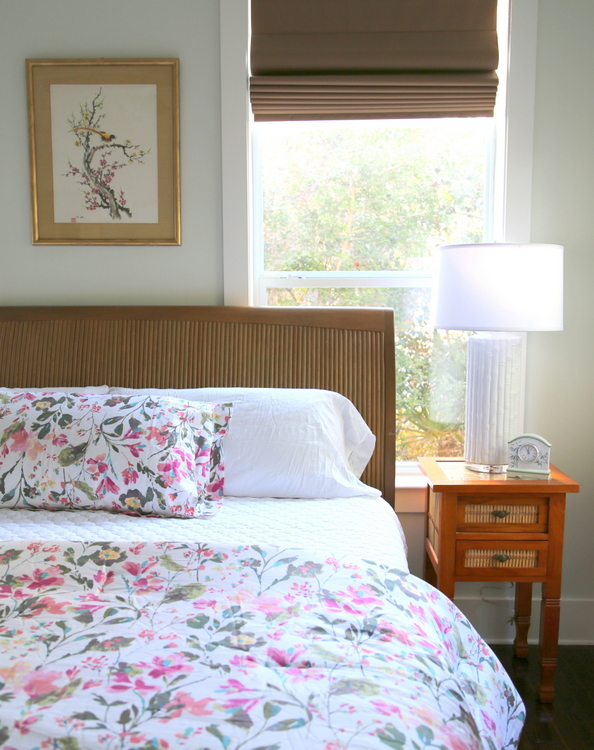
Yes, metamerism. That’s because light affects paint colors. Colors seem to change under different light conditions. It may be the same color, but the way you perceive it changes depending on the lighting condition. That’s why it’s never good to choose a paint color from an online photo or while standing in a paint store in front of a few thousand sample chips.
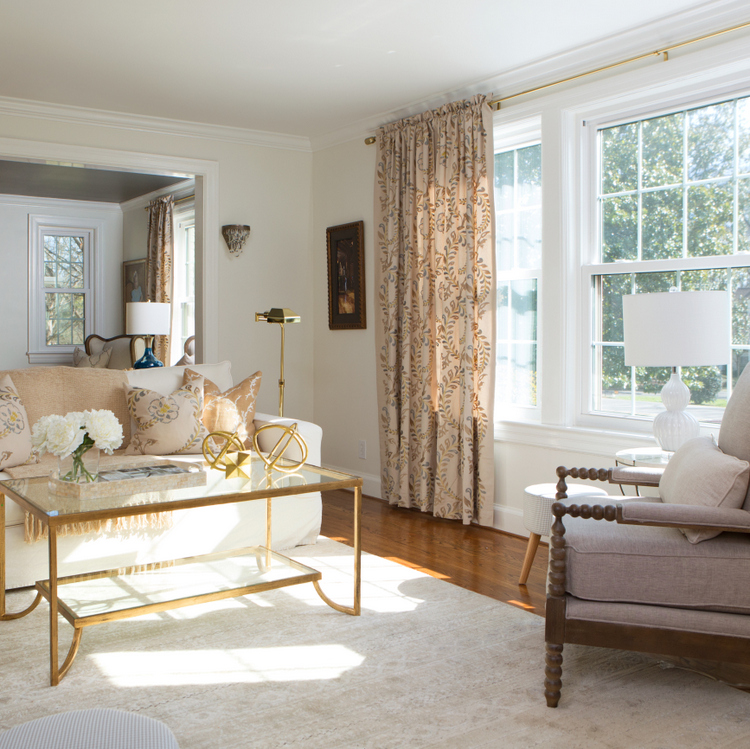
You really need to look at color samples in the actual space you are going to paint. It’s also good to look at it in the daytime and the nighttime, and with lamps on and off. I’ve had clients say to me: “But this color looks different at night!” Of course it does.
Since light affects paint colors, it’s actually impossible for a paint color to look the same in all lighting conditions.
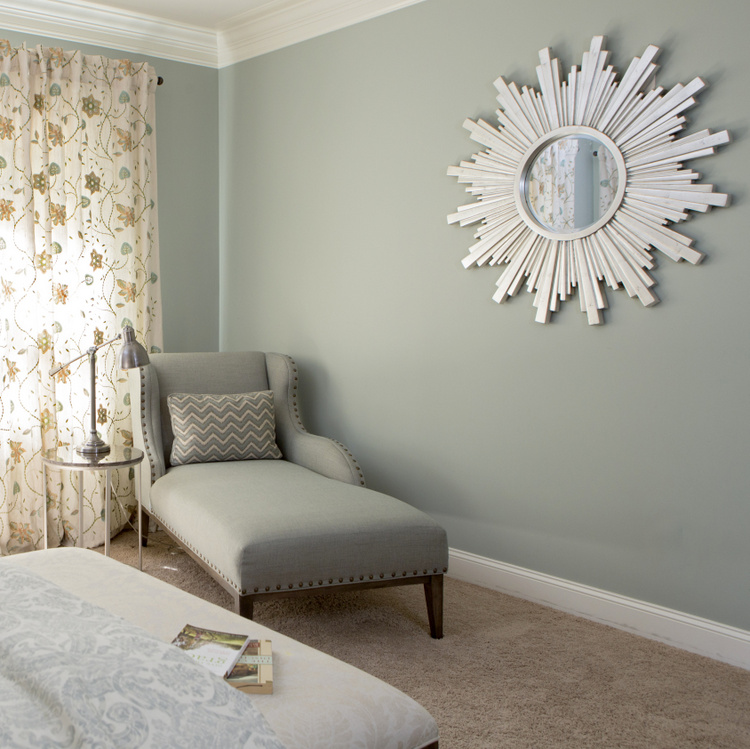
Choosing paint colors in natural sunlight is ideal. Natural sunlight provides the neutral balance between warm and cool ends of the light spectrum (yellow and blue, respectively). Northern light is the coolest, while southern exposure is the most intense. If you paint two rooms – one with a northern exposure and one with a southern exposure – the wall color will look different in each room.
Even natural sunlight isn’t consistent. It changes throughout the day and varies if it’s cloudy or clear. The shadows created by an overcast day impacts how the wall color looks, as well.
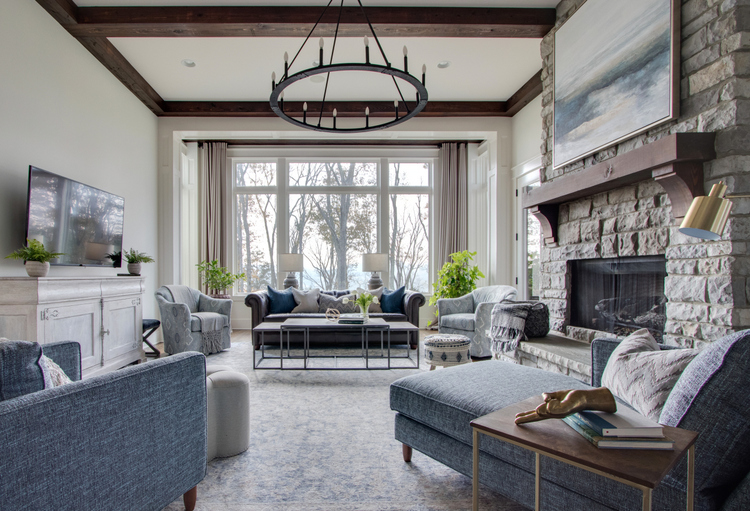
What about overhead lighting and lamp light? Incandescent and halogen lights enhance reds and yellows and mute blues and greens. Fluorescent lights enhance blues and greens and mute reds and yellows. To further complicate things, wall color lit from above is going to look a bit different than wall color lit from floor and table lamps.
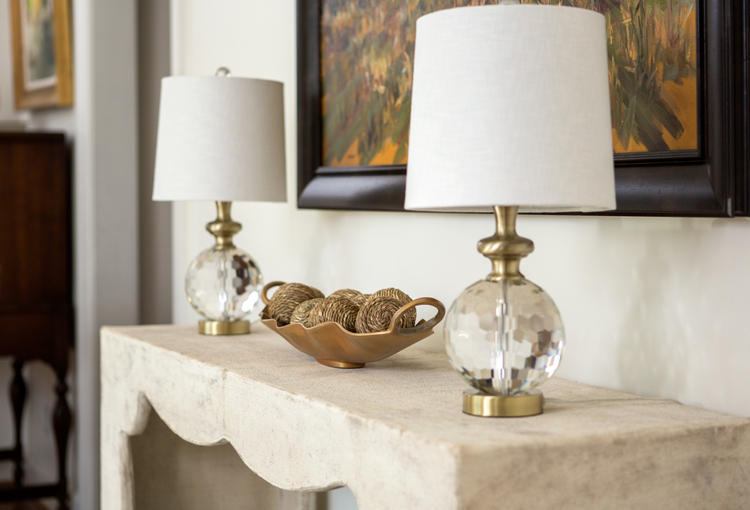
Some colors are more metameristic than others. Grays, taupes, gray-blue, gray-greens, lavenders, and mauves are particularly affected by lighting conditions. These can be chameleon colors, which make them more interesting. You are less likely to tire of them quickly, as long as you choose the right ones with the right undertones.
If you need a color intervention, contact The Decorologist to schedule a consultation. Because you really don’t want to have to paint twice (or more). Or better yet, you can learn how to choose the best colors and create amazing color palettes for any home’s interior by taking my professional certification program to become a paint color expert yourself! Find out more here or by clicking the image below:









so with that in mind – what do you think about those machines at Home Depot, et al, that allow you to bring an object and “match” the color in a paint? I’m guessing fabric alters color perception too?
Yes Lee, fabric is tricky to use to “match” to a paint color. Those computers need something flat and solid-colored to scan to get the right color. I have a hand-held version myself, and it’s a very useful tool. But frankly, I don’t use it to get a paint color from an object – I use it to find out what paint color is on a given wall. The reason I don’t use it to get an exact match from an object is because that creates a “matchy-matchy” look that I think falls a little flat. I’d rather go a little darker or lighter on the walls when I am using an object as the inspiration piece for that color. The color in a couple of shades looks more interesting in a room than only one shade of it – you get a more “collected over time” feel, rather than a rooms-to-go feel. Hope that makes sense! To your last question: texture definitely alters paint, as does the sheen of the paint finish. But I’ll discuss that one later . . . 🙂
Love this post!! I tell my clients about this alllllll the time. Its why I always make samples first and make them tape them up all around the room and look at them (posterboard size) in different lighting conditions. Cool. I Learned a new vocab word. Now I can wave that around on appointments.
such a good post….and so true…good advice for everyone painting a new color.
thanks, dianne!
This is such a cool post, and a great vocab word. Maybe that’s why I like grays so much-they’re never the same.
Does this hold true when you start changing the texture of the paint? Like would a flat paint change as much as a glossy?
Texture and sheen definitely impact the way colors are perceived. And there are other things – I’ll talk about those in my next post in this series!
great post, Kristie! this is such an important color “issue” and you’ve explained it in a very clear, easy-to-understand way. lucky readers and clients, you have!!!
Thanks for becoming a follower on Naturally Carol, I am only too pleased to reciprocate, you have a beautiful blog. I can tell I am going to spend many pleasant hours here wandering from picture to post, scattering comments as I go!
Spot-on advice. I might add, I always encourage my customers to put up BIG patches of the color, 2-3′ square. And place samples on more than one wall – sometimes in a room, there is that one tricky corner where the color looks different from anywhere else. You don’t want to accidentally make your decision based on that one corner.
Just found your website and love it. Keep up the good work!
Actually the phenomenon you are describing is inconstancy, not metamerism. The former describes the apparent change in a single color as light changes, while the latter describes the change of one color compared to another under different lighting (like selecting a chip that matches a fabric in in the store only to find that the chip no longer matches under tungsten light in your home). Inconstancy is driven by the nature of the color itself while metamerism is driven by differences in the mix of pigments or dyes that were used to make the two colors – it’s why so many so-called color matches often do not match very well as the light changes.
I just painted my walls in my livingroom and hallways a peach tone called coral dune from BEHR paint. The paint sample looks peach but the walls that get eastern and western light look really pink to me. Can I fix this?
I was wondering if the peach tones do this? I painted my walls with eastern and western lighting a meduim peach tone BEHR coral dune and some walls look peach and others look pink. How can I fix this? Darker lighter new color? HELP!
I’ having the same problem as Jackie i.e.,we’ve painted our bathroom and dressing room the same color, Behr’s Coronado Dunes. Each room has a skylight, but on opposite walls so the bath gets the morning sun and the dressing area gets the afternoon sun. The bathroom is peachand the dressing room very pink! They clash horribly. We tried deepening the color with more brown pigment, but the differences still occurred. Has anyone found a solution to this light problem?
The problem isn’t the light, it’s the particular paint color you have chosen. Your paint has red in it, giving it a pink and peach effect depending on lighting. If you chose a beige with a yellow or green undertone, this wouldn’t be happening. Sorry! You can’t choose a peach paint and expect it not to look, well, peachy!
Natural sunlight provides the neutral balance between warm and cool ends of the light spectrum (yellow and blue, respectively). Northern light is the coolest, while southern exposure is the most intense. If you paint two rooms – one with a northern exposure and one with a southern exposure – the wall color will look different in each room. Incandescent and halogen lights enhance reds and yellows and mute blues and greens. Fluorescent lights enhance blues and greens and mute reds and yellows. To further complicate things, wall color lit from above is going to look a bit different than wall color lit from floor and table lamp
Jackie, I am having the exact same problem. Haven’t found an answer yet. 🙁
I have the same problem! I just painted my bedroom walls a lillac shade (BM-Pale Iris). In some lights, its very pink, and others its more purple. What I can do to tone down the pink? Definetely did not think it would turn out this pink !!
Thanks
Love your site, btw!
Rose,
Not all colors can work (the way you want them to) in all rooms and lighting conditions. The color you chose is very pinky. I recommend you choose a purple bedroom color that has more blue in it rather than red, like Lavender Mist. Good luck!
I just painted my bedroom walls a what I thought was going to be a medium grey lavender. The lights in my room turn the top of my room pink. I was wondering what I should to inorder to prevent it from turning pink. (like what kind of lights to use, exc.
I just painted my bedroom walls what I thought was going to be a medium grey lavender. The lights in my room turn the top of my room pink. I was wondering what I should to inorder to prevent it from turning pink. (like what kind of lights to use, exc.
We are building a house with an open floor plan and have a room with both northern and southern exposure! Of all the choices I am making (and there are lots!), choosing paint is making me neurotic- which is how I found this blog. Any suggestions on how to do an open floor plan with northernwest and southeast exposure (both major windows will have porches over them, if that matters)?
I painetd a room a salt white color, (blue tinged). The room felt like an overcast day outside. I felt I made a big mistake. I upped the power of the halogen spots from 20 to 35 watts and the result was that color now became interesting.
Before repainting a room, when you think you made a bad color choice, look at tweaking your lighting.
Great point and very true!
Thank you for these tips! It’s the most help i’ve found about how lighting will effect my paint color. I still have a question though. We recently painted our living room and kitchen a very light blue color. I really like the color during the day because it’s very subtle and is more of a white with slight/subtle blue tint. However, when it gets dark the color turns into an obvious baby blue. Such a drastic change! My accents are mostly teal colors, so during the evening, everything is just too blue! I’m wondering if Incandescent and halogen lights (which were said to enhance reds and yellows and mute blues and greens) would dull & brighten that baby blue color to more of a white-like color, closer to how it looks in the daylight? I really don’t want to repaint, but am starting to consider it. Any suggestions would be great!
You could certainly experiment with you lighting, but this is a common problem with light blues that don’t have enough gray in them to keep them from going nursery, baby-boy blue! Next time, look for a gray with a blue undertone – it will come out bluer than it appears on a small swatch without looking baby blue.
Great post. I am shopping for houses in the Seattle area and am already dreaming about painting one to suit my tastes. I was wondering what advice you might have regarding choosing paints for overcast skies? I love Seattle, and have recently returned after years away from my childhood home, but I hate the constant grayness. I want something that will make the interior seem sunny, even though there is often not much sun outside. I was thinking of upping the gloss factor by going satin. Do you think that would work? Any colors that you might recommend? Thanks so much!
Eliza,
I’d go with cleaner, brighter colors than I might choose in another part of the country (where I might choose more muted ones). Think saturated pastels with black/white/gray rather than earth tones and browns.
Hi Kristy,
we are renting a furnished apartment for 2 months while our new house is getting ready. unfortunately the spacious living/dining area is painted pink – is there anyway to use lighting colour to change this effect? thank you , Carolyn in Toronto /Canada.
I painted a room with Benjamin Moore’s “Summer’s Blue” and it looks very purple under the overhead fluorescent lighting (it’s my office at work). What kind of fluorescent lightbulb would work best being overhead to make it more blue and less purple? In natural light it looks more blue but I have no clue how to imitate that with artificial lighting as best as possible. Any help would be appreciated!
See if you can find any CREE LED lighting options for your office ceiling light. They are the best bulbs I’ve found – I prefer soft white because “daylight” can be a bit harsh. Check out their website or Home Depot, where they are sold.
Hi,
I just found this website. I have a question that I hope you can help me with. I just painted my bathroom Lazy gray from Sherwin-Williams. One whole section looks a beautiful light gray which is what I wanted. The other part with a north facing window is definitely purple. Depending on the time of day and the lighting it is either a periwinkle or a lavender, but ALWAYS purple. What can I do???